
“Budget travel” has a reputation problem.
Mention it and most people picture hostels with questionable bathrooms, 5am bus connections to save twelve dollars, and eating gas station sandwiches for dinner. The implicit assumption is that traveling on a budget means experiencing less — fewer comforts, fewer experiences, more compromise.
That assumption is wrong. And it costs people real money.
The travelers who consistently get the most out of their trips — who eat well, stay somewhere they love, and come home with experiences worth talking about — aren’t necessarily the ones spending the most. They’re the ones spending intentionally. They’ve figured out where the real value is and where they’re just paying a premium for convenience or familiarity.
This is a guide for doing exactly that. Not “spend less on everything.” Spend less on the things that don’t matter so you can spend properly on the things that do.
The Mindset Shift That Changes Everything
Most budget travel advice is about subtraction: skip this, cut that, avoid the other thing. The problem with pure subtraction is that it turns a trip into a series of compromises — and after enough compromises, you’re not really experiencing the place anymore, you’re just surviving it cheaply.
A better frame: every trip has a finite budget, and the goal is to allocate it well.
That means identifying, before you book anything, what actually matters to you on this trip. Is it the food? A particular experience you’ve been thinking about for years? The comfort of where you sleep? Being in the right neighborhood? Once you know what matters, everything else becomes negotiable — and the savings you find in the “doesn’t matter” column fund the things that do.
Someone who doesn’t care about accommodation but lives for restaurants should stay somewhere basic and eat somewhere exceptional. Someone who cares deeply about where they sleep but could take or leave sightseeing should book somewhere they love and be selective about activities. Neither approach is right or wrong. Both beat the generic strategy of trying to save a little on everything and ending up with nothing that feels worth having.
Before You Book: Where the Real Savings Are
The single biggest determinant of your trip’s total cost isn’t what you do when you get there — it’s the decisions you make before you leave. Specifically: when you book, where you’re going, and when you’re going there.
Timing your bookings
Flights are priced dynamically, which means the same seat can cost dramatically different amounts depending on when you buy it. For major trips, starting to plan 6–12 months in advance gives you time to watch for deals, research accommodation options, and save adequately — rather than paying whatever the market demands when you finally get around to booking.
The general rule: book flights further out, especially for international travel or peak periods. For accommodation, booking early locks in better rates and gives you more options, but last-minute deals do exist for flexible travelers.
Flexible dates
Mid-week flights are often 30–50% cheaper than weekend departures — a gap that can fund a meaningful chunk of your activities budget. If your schedule allows even a day or two of flexibility around your travel dates, use a flexible date search tool before committing to specific flights.
Shoulder season
Peak season is expensive because everyone wants to go at the same time. Traveling in the month or two on either side of peak season means fewer tourists and lower prices — and often better weather than you’d expect, since “peak” is as much about school holidays and perception as it is about conditions.
Shoulder season is one of those travel secrets that’s technically public knowledge but practically underused. Popular sights are quieter, easier to move through, and easier to enjoy. The prices are genuinely lower. The experience is usually better.
Destination choice
The country you choose matters as much as any other decision. A week in Southeast Asia on the same budget that buys you three nights in Scandinavia gives you a fundamentally different set of experiences to work with. Destinations with lower demand typically offer lower prices, and some of the most rewarding travel is to places that haven’t been optimized for mass tourism yet.
If your dream destination is out of budget, it’s worth asking whether there’s a comparable place that offers a similar experience at a fraction of the cost. Portugal vs. France. Colombia vs. Brazil. Vietnam vs. Japan. The trade-offs are real, but so are the savings.
The Budget Categories That Actually Matter
Once you’re committed to a destination and dates, here’s how to think about allocating your budget across the categories that make or break a trip.
Flights: spend smart, not necessarily cheap
Cheap flights that require three connections and a 4am departure technically save money while costing you in energy, time, and the experience of arriving somewhere and feeling like you need another day to recover.
The goal isn’t the lowest possible fare — it’s the best value fare. One connection with a reasonable layover is usually worth a modest premium over a routing that eats a full day of your trip.
Accommodation: location over stars
This is where the most important accommodation decision lives, and it’s not about price — it’s about location. Staying in the right neighborhood means you can walk to things, orient yourself quickly, and spend less time and money on transport. Staying somewhere cheap and remote often ends up costing more when you factor in taxis, ride-shares, and the time lost moving between areas.
Hotels have risen significantly in price in recent years, making alternatives like guesthouses and vacation rentals genuinely more cost-effective while often offering a more personal experience. These alternatives have the added advantage of often being in residential neighborhoods rather than tourist zones — which tends to be both cheaper and more interesting.
Food: the biggest lever most people ignore
Food is where most travelers either waste significant money or miss the best experiences of their trip — often both at once.
Eating like a local — street food, food markets, neighbourhood spots away from tourist areas — is both more affordable and more representative of what the place actually tastes like. The restaurants on the main tourist drag with menus in six languages and a host outside aren’t where the locals eat. They’re not usually where the best food is either.
A practical approach: have one proper sit-down meal a day at somewhere worth the bill, and eat well and cheaply for the other meals. Markets, bakeries, local lunch spots, and street food cover the rest without the markup.
Activities: free is often better
Some of the best experiences in any destination cost nothing. Walking a neighborhood. Stumbling into a local market. Sitting in a square and watching the place move. These aren’t consolation prizes for the experience you couldn’t afford — they’re often what people remember most.
Beyond that, most cities have genuinely excellent free or low-cost options: public museums, parks, coastlines, hiking, walking tours. Checking local museum free-entry days and building your schedule around them is a minor planning step that can save meaningful money on a longer trip.
For paid experiences, the principle from the opening applies: spend on the things that matter to you and be selective about the rest. One extraordinary experience — a cooking class, a guided hike, a long tasting menu — funded by cutting five mediocre ones is better travel.
Transport: local is almost always cheaper
Public transit — buses, trains, metros — is almost always dramatically cheaper than taxis and rideshares, and many cities offer day passes or tourist cards that make it even better value. Beyond cost, using local transport puts you in the city rather than looking at it through a car window.
For getting between cities, trains and buses often beat flying once you factor in airport time, security, and the transfer at both ends. Overnight trains in particular are a budget traveler’s hack that doubles as accommodation.
The Costs People Forget Until They’re Already There
A realistic budget isn’t just flights, hotels, and restaurants. The costs that catch people out are almost always the ones they didn’t think about during planning.
The things most people underestimate:
- Airport transfers — often significantly more expensive than in-city transport, especially late at night
- Checked baggage fees — on budget carriers these can add up to more than the base fare
- Visa and entry fees — some destinations charge meaningful fees on arrival or require paid applications in advance
- Tips and service charges — norms vary significantly by country; not knowing them costs money in both directions
- Tourist taxes — city and hotel tourist taxes are now common across Europe and Asia and rarely show up in initial price searches
- ATM and foreign transaction fees — using the wrong card or the wrong ATM is an avoidable ongoing cost across a whole trip
- The “I’ll figure it out when I get there” activities — which you book at full price, without comparison shopping, because you’re already there
A practical rule of thumb is to add 15–20% to your initial budget estimate to cover these often-forgotten costs. Not because you’ll spend it all, but because having it means you’re not making decisions under financial pressure in the middle of your trip.
Tracking Your Budget: The Difference Between Planning and Knowing
Making a budget before a trip is useful. Knowing where you actually stand during a trip is what keeps you from coming home to a credit card statement that contradicts your memory of a “pretty affordable” week.
The gap between the two is usually not deliberate overspending — it’s accumulated small decisions made without a running total. A round of drinks here, a taxi instead of a metro there, a last-minute tour that seemed reasonable at the time. Individually none of them are the problem. Together they’re often why the final number is higher than expected.
Tracking doesn’t mean being precious about every coffee. It means having a number in your head — or somewhere quickly accessible — so you can make the trade-off consciously: “we’ve spent more on food than planned, so let’s find a cheaper option tonight” is a decision you can only make if you know you’re over on food.
The simplest system is a shared running total updated as you spend, split by category. Nothing elaborate. Just enough visibility to make intentional decisions rather than surprised ones at the end.
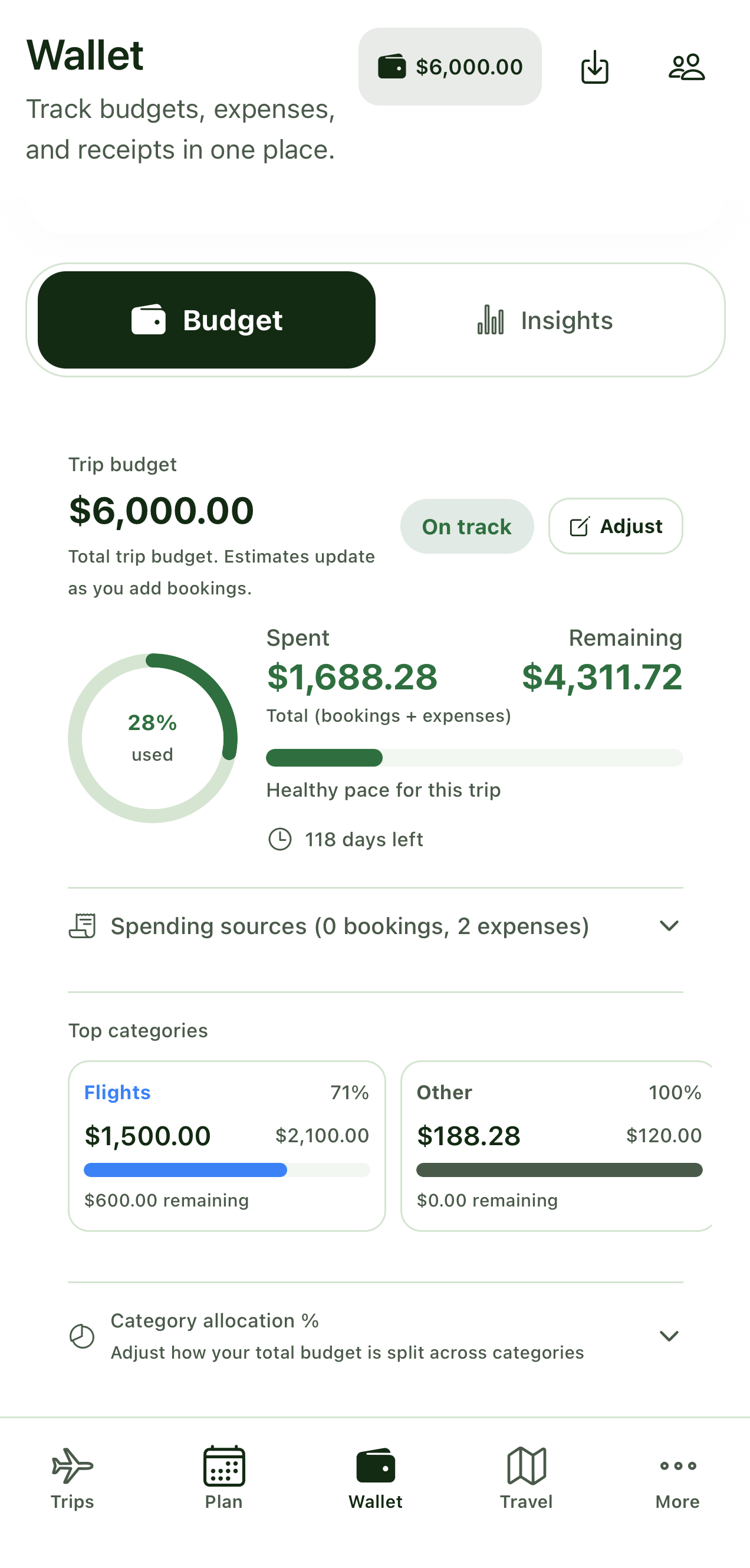
Tripvio’s budgeting and expense tracking is built around this exact idea — set a total trip budget, log expenses as they happen (including splitting costs across travel companions), and see at any point in the trip where you stand. The goal isn’t to constrain the experience. It’s to fund it properly by staying in control of the numbers throughout.
The Real Secret to Budget Travel
There isn’t one trick. But if there’s a principle that ties everything together, it’s this: most of what makes a trip memorable costs less than you think, and most of what costs the most is the least memorable.
Nobody comes home talking about the hotel lobby. Nobody recommends the tourist restaurant on the main square. Nobody regrets skipping the overpriced tour that covered in two hours what a half-day of walking would have shown you for free.
The experiences worth having — the food that was genuinely extraordinary, the place you stayed that had actual character, the morning you spent somewhere without a plan and ended up somewhere you didn’t know existed — these are not primarily a function of budget. They’re a function of intentionality.
Plan with that in mind, track the numbers so you stay in control, and spend freely on the things that actually matter. That’s budget travel done right.
Plan and track your next trip’s budget in Tripvio → tripvio.app