
Every great trip starts the same way: a half-serious comment in a group chat, a photo that stops your scroll, or a quiet moment where you think I need to go somewhere.
What happens next — the planning, the logistics, the decisions, the actual trip — is where most people get buried. Group threads spiral. Screenshots pile up. Bookings live in five different email threads. And by the time you land, you’ve already forgotten half of what you wanted to do.
This is the guide for doing it better. From that first spark of inspiration all the way to reliving the memories, here’s how a trip actually unfolds — and how to stay organized through every phase.
Stage 1: The Spark — Dreaming and Deciding Where to Go
The dreaming phase is chaotic by nature. You’re pulling ideas from Instagram, TikTok, a friend’s recommendation, a podcast, a Reddit thread from 2019. Everyone in your group has a different vision. Someone wants beaches. Someone wants mountains. Someone just wants good food and a slow pace.
Before anything else, you need to answer a few questions:
- What kind of trip is this? Adventure, relaxation, culture, food, a mix?
- Who’s coming? Solo, couple, friends, family — this shapes everything.
- What’s the rough budget? Even a ballpark number helps narrow destinations fast.
- When are you going? Flexibility here opens up a lot of doors.
The mistake most people make in this phase is going too deep too fast — researching flights to five cities before anyone’s agreed on a continent. Get alignment on the basics first, then zoom in.
Pro tip: Keep a shared “trip wishlist” where everyone can drop ideas without pressure. The goal at this stage is to generate options, not make decisions.
Stage 2: Planning — Turning an Idea Into an Actual Trip
This is where most trips either come together or fall apart.
Good planning isn’t about having every minute scheduled. It’s about answering the questions that will actually matter when you’re there:
The essentials to nail down early:
- Dates — Lock these in before anything else. Everything flows from here.
- Flights — Set fare alerts and book when you find a good price. Don’t overthink this.
- Accommodation — Know what neighborhoods you want to be in before you book. Location matters more than star ratings.
- Visas and entry requirements — Check early. Some countries need applications weeks or months in advance.
- Travel insurance — Not glamorous, but genuinely important.
Building your itinerary:
The best itineraries have a loose structure, not a rigid schedule. Think in terms of areas and themes rather than hour-by-hour plans. Group activities geographically so you’re not spending half your trip in transit.
A good framework: plan 2–3 anchor experiences per day (a neighborhood, a landmark, a meal), and leave the rest open. The best travel moments are almost always unplanned.
What most people forget at this stage:
- Emergency contacts and local numbers
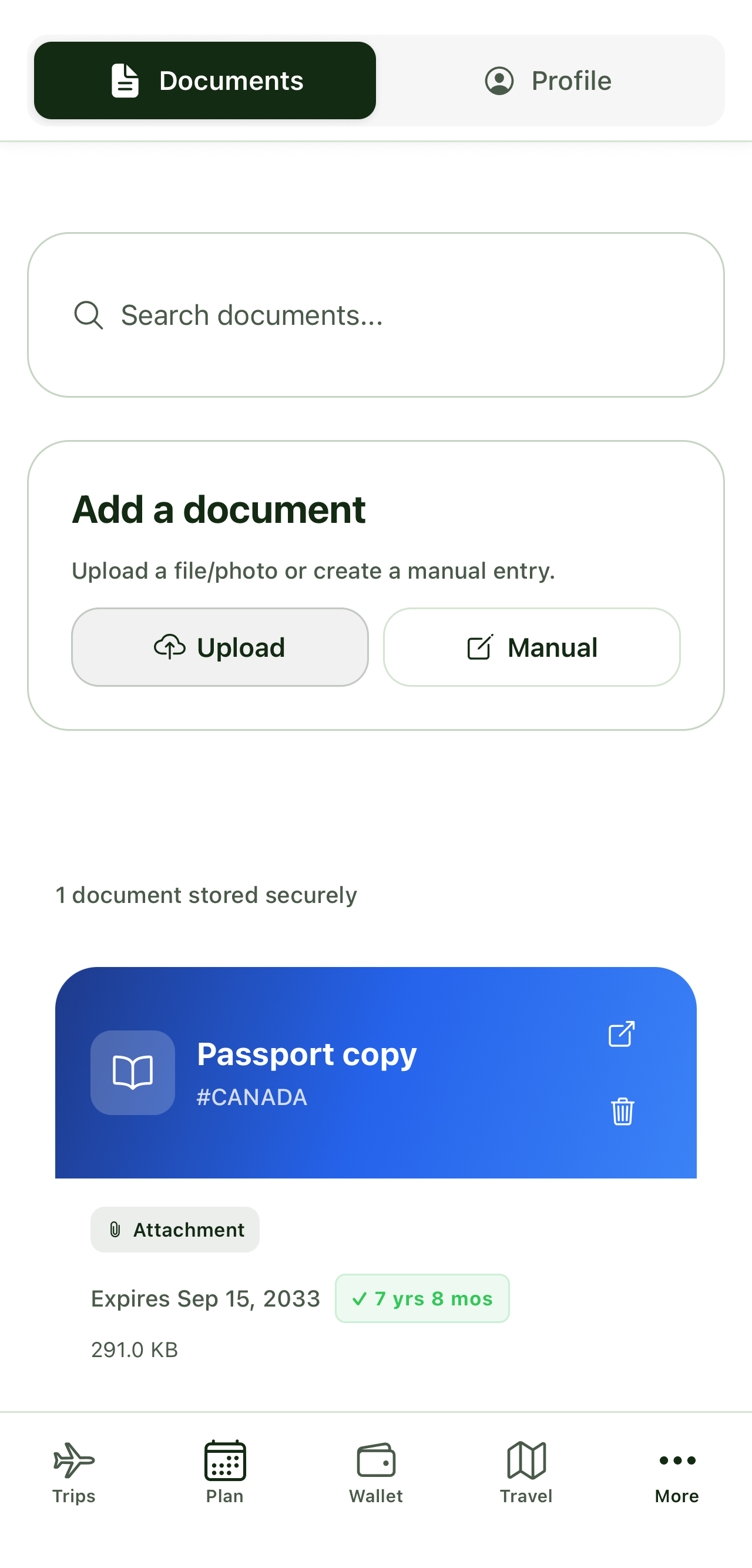
- Copying important documents (passport, insurance, bookings)
- Notifying your bank of travel dates
- Downloading offline maps for your destinations
Stage 3: The Pre-Trip Checklist — The Week Before You Leave
The week before a trip is its own kind of stress. Work is piling up, you’re trying to pack, and you’re suddenly realizing you don’t actually know what time your first flight is.
This is where having everything in one place pays off. Your itinerary, your bookings, your documents, your travel contacts — all of it should be somewhere you can access quickly, even without Wi-Fi.
The pre-trip essentials:
- Passport and ID (check expiry — many countries require 6 months validity beyond your travel dates)
- All booking confirmations in one place
- Travel insurance policy and emergency number saved
- Currency or international payment card sorted
- Key addresses downloaded offline (hotel, airport, first day activities)
- Shared itinerary sent to travel companions (and someone staying home)
- House sorted — plants watered, pet covered, mail held
On packing: Pack for the activities, not the destination. Most people overpack. If you’re going somewhere warm for a week, you need fewer clothes than you think and more comfortable shoes than you own.
Stage 4: The Trip — Actually Being There
Here’s the thing about travel that no one tells you: being organized in advance means you can be completely spontaneous once you arrive.
When your bookings are confirmed, your itinerary is set, and your documents are sorted, you stop managing logistics and start actually experiencing the place. You can say yes to the thing a local recommends. You can change your plans without panic. You can stay an extra hour somewhere because you don’t have to be somewhere else.
How to make the most of the actual trip:
- Check in with your itinerary each morning, not to follow it rigidly, but to give the day a loose shape.
- Track your spending as you go — not obsessively, but enough that you’re not shocked at the end.
- Take photos of things that matter, not just things that look good — the menu you loved, the address of the shop you want to recommend, the view from that hill.
- Keep important documents accessible — not buried in a bag somewhere.
- Stay flexible — weather changes, places close, things happen. The ability to adapt is more valuable than any itinerary.
If you’re traveling with others, this is also the time when the “who’s paying for what” question gets complicated. Get ahead of it by tracking shared expenses and settling up as you go rather than trying to reconstruct everything at the end.
Stage 5: After the Trip — Memories and Lessons
Most travel content stops at the trip itself. But what happens after matters more than people realize.
Practically speaking:
- Reconcile your shared expenses while the details are fresh
- Back up your photos before you do anything else
- File any travel insurance claims promptly if you need to
- Write a quick note on what you’d do differently — you’ll thank yourself when planning the next one
The part no one talks about: The post-trip slump is real. Coming home after a meaningful trip can feel jarring. The antidote isn’t just scrolling through your camera roll — it’s doing something intentional with what you brought back.
Make the memories physical
There’s something about holding a trip in your hands that a photo album on your phone can’t replicate. A few ideas worth the small effort:
Fridge magnets. Cheesy? Maybe. But every time you open the fridge, you get a tiny hit of that trip. A magnet from a city, a landmark, a market you stumbled into — it’s a low-effort way to keep a place present in your daily life. Collect enough and your fridge becomes a map of everywhere you’ve been.
A printed photo wall or clip board. Pick 8–12 of your best shots — not the most technically perfect ones, the ones that actually capture how the trip felt — and print them. A corkboard with photos, ticket stubs, a restaurant receipt, a hand-drawn map from a local — that’s a memory you can walk past every day. Services like Printful, Chatbooks, or even your local pharmacy make this easier and cheaper than it’s ever been.
A travel journal. You don’t need to write essays. Even a few sentences per day — what you ate, what surprised you, who you met, what you felt — turns into something genuinely moving to read years later. Pair handwritten notes with printed or taped-in photos, a dried flower from a market, a sticker from a hostel. The messier and more personal, the better.
If journaling felt like homework in school, try a different format: bullet points, sketches, one sentence per day, or even voice memos you transcribe later. The goal is capture, not craft.
A trip recap for the group. If you traveled with others, put together a simple shared album or a quick recap of the highlights — funny moments, best meals, the thing that went wrong and became the best story. It’s a small gesture that keeps the connection alive after everyone goes back to their routines.
Why this matters more than people think
Physical mementos and written memories do something that digital photos don’t: they force you to edit. When you’re choosing which 10 photos to print, or writing down the three things you want to remember from a day, you’re making meaning out of the experience rather than just archiving it.
The best trips don’t end when you land. They become the stories you tell, the magnets on your fridge, the journal you pick up years later and can’t put down.
Keeping It All Together
The reason trip planning feels overwhelming is that it’s spread everywhere. Ideas in DMs. Bookings in email. Itineraries in notes apps. Documents in email threads you can’t find. Everyone doing their own version of the plan.
The whole point of Tripvio is to pull all of that into one place — from the first idea to the last expense. Plan manually or use templates, build your itinerary and watch it appear on a map, sync your travel emails automatically, track what you’re spending, collaborate in real time with your travel companions, and store your documents where you can actually find them.
Your whole trip. One app.
Ready to plan your next one? Get started with Tripvio