
You’re at the check-in desk. The agent asks for your hotel confirmation. You open your email, type in the name, scroll through 30 results because you get emails from the same chain constantly, can’t find the right one, try searching by date, find it, screenshot it, try to show it, but your phone screen just locked and now you’re fumbling to get back in while the queue behind you grows.
You’ve been through this. Everyone has.
It’s not that you’re disorganized. It’s that travel documents are scattered across every app and platform you use — and they only need to be in one place at one critical moment to matter. That mismatch is what makes the scramble feel so bad when it happens.
Here’s why it keeps happening, what’s actually at stake when it does, and how to fix it properly before your next trip.
The Real Reason Documents Go Missing
It’s not carelessness. It’s architecture.
Think about where your travel documents actually live:
- Flight confirmations: email
- Hotel bookings: email (different thread, different sender)
- Tour reservations: a booking platform app you only open when traveling
- Visa approvals: an email from three months ago, possibly in spam
- Travel insurance policy: a PDF you downloaded and immediately lost
- Car rental: another email
- Passport photo / copy: maybe in your camera roll, maybe not
- Emergency contacts and embassy numbers: …nowhere
None of these are in the same place. None of them are organized in any logical order. And all of them need to be accessible instantly, often at a moment when you’re tired, rushed, jet-lagged, or in a foreign country where you can’t easily get help.
The documents aren’t missing — they were never together in the first place.
What Actually Happens When Documents Go Wrong
Most of the time, the scramble ends with mild embarrassment and a two-minute delay. But sometimes it’s genuinely serious.
At the airport. A misplaced boarding pass means re-checking in. A missing passport copy (if the original is lost or stolen) makes getting an emergency replacement significantly harder. If you lose your passport abroad, officials strongly recommend having a photocopy of it alongside a birth certificate or other proof of citizenship — both to report the loss and to speed up replacement at the embassy.
At the border. Entry requirements vary by country. Some need proof of onward travel. Some need proof of accommodation for the first night. Some need a visa approval email printed, not just shown on a phone. Getting caught without the right document at the wrong border is a genuinely trip-ending scenario.
If something goes wrong mid-trip. This is the one people underestimate most. If you’re in a medical emergency abroad, the people helping you need to know your insurance policy number and the emergency contact line — fast. If your phone dies or gets stolen, those details need to exist somewhere accessible. Without your documentation readily available, a stressful situation becomes an overwhelming one.
Filing a claim after the trip. Travel insurance exists for a reason. But claims require documentation — receipts, confirmation numbers, incident reports. If you don’t have those stored somewhere, you often can’t claim for the thing you paid to insure.
The Documents You Actually Need (That Most People Forget)
Here’s a complete list. Not the obvious ones — the ones people miss.
Identity and entry:
- Passport (physical) + a scanned digital copy stored separately
- Visa approvals or e-visa confirmation emails
- Entry requirements for every country on the itinerary (these change — always check before you go)
Transport:
- Flight confirmations with booking references
- Train / bus / ferry bookings
- Car rental confirmation
- Any transfers or airport shuttle bookings
Accommodation:
- Hotel / Airbnb confirmation for every night
- Check-in instructions, especially for self-check-in properties
- Address in local language (useful for taxis)
Insurance and safety:
- Travel insurance policy document
- Emergency claims number (not just the general number — the 24/7 emergency line)
- Your home country’s embassy address and emergency number for each country you’re visiting
- Blood type and any critical medical information
Financial:
- A note of your bank’s international fraud/lost card number
- Photo of the front and back of each card you’re traveling with, stored somewhere secure
Activity bookings:
- Tour confirmations
- Entry tickets (many are time-entry now — the time matters)
- Restaurant reservations
If reading this list makes you realize you’d need to dig through four apps and six email threads to find all of it — that’s the problem exactly.
The Pre-Trip Document Checklist
Getting organized before you travel isn’t about being rigid. It’s about making sure that the first time you need a document isn’t also the first time you try to find it.
Here’s what to do in the week before any international trip:
1. Collect everything in one place.
Gather every confirmation, booking, approval, and policy into a single folder or app — organized by trip date, not by sender or platform. The goal: you should be able to find any document within ten seconds.
2. Check your passport expiry.
Many countries require your passport to be valid for at least six months beyond your travel dates. This catches people out more often than you’d think — not because the passport has expired, but because it expires too soon after the trip ends.
3. Save copies offline.
Your boarding pass, hotel confirmation, travel insurance emergency number, and passport copy should all be accessible without internet. There will be moments — border crossings, remote areas, dead phone batteries — when you need them and have no signal.
4. Share key details with someone at home.
Give a trusted person your itinerary, accommodation details, emergency contacts, and a copy of your passport. If anything goes seriously wrong, they need to be able to act quickly on your behalf.
5. Know the emergency numbers before you need them.
Your travel insurance emergency line. Your country’s embassy in each destination. Your bank’s international lost card number. These are not things you want to Google from a hospital waiting room in a country where you don’t speak the language.
The Passport Copy Rule Nobody Follows (Until They Need It)
Travel experts consistently advise keeping a photocopy of your passport and storing it separately from the original — in a different bag, with a travel companion, emailed to yourself, or saved securely in the cloud. This single habit can dramatically speed up emergency passport replacement if the original is lost or stolen.
When applying for an emergency replacement passport abroad, having a photocopy of your missing document — alongside proof of travel itinerary — significantly helps the process at the embassy or consulate.
Most people know they should do this. Almost nobody does it before their first serious travel incident.
On Travel Insurance: The Document Nobody Reads Until It’s Too Late
Travel insurance is one of those purchases that feels unnecessary right up until the exact moment it becomes the most important thing you’ve ever bought.
A few things worth knowing:
- The document that matters in an emergency isn’t the summary email — it’s the full policy, because that’s where the emergency contact number and claims process live.
- Most travel insurance has a 24/7 emergency medical line that’s separate from the general claims number. That number should be in your phone before you leave.
- Claims almost always require documentation: receipts, confirmation numbers, incident reports, medical records. If you don’t save these during the trip, you often can’t claim afterward.
None of this requires you to become paranoid about travel. It just requires the information to exist somewhere you can get to it.
Keeping It All Together
The document problem is fundamentally a storage problem. You could solve it with a well-organized folder in your email, a dedicated notes file, or a cloud storage folder you maintain consistently. Any system is better than no system.
What makes the difference in practice is having it built into your trip planning process — so gathering and storing documents isn’t a separate task you do the night before you leave, but something that happens naturally as you book each thing.
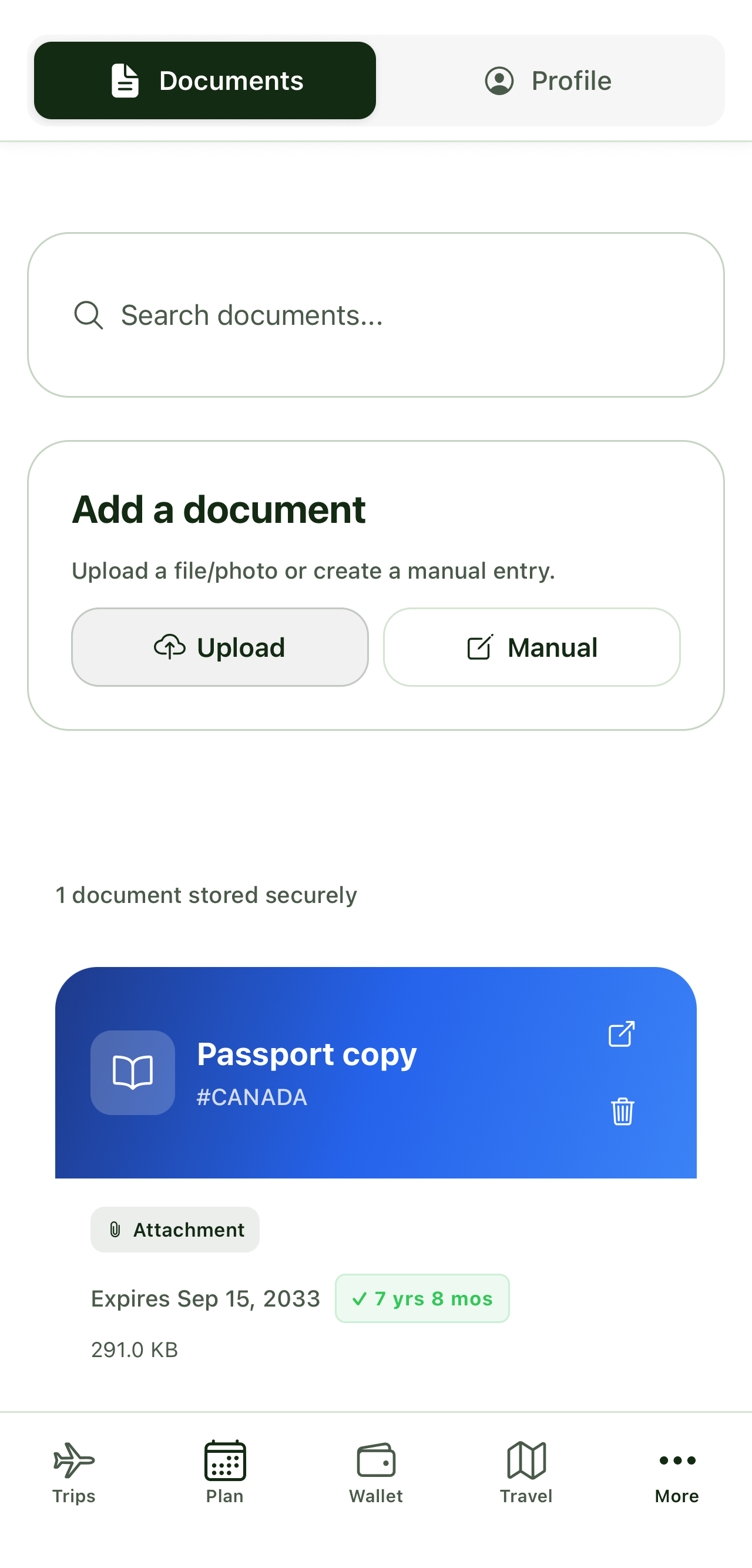
Tripvio’s document storage and safety hub is built around exactly this idea. As you plan your trip, you store documents alongside the relevant part of the itinerary — hotel confirmation lives next to the hotel, flight details next to the flight, insurance policy in your safety hub with the emergency numbers already surfaced. Everything is accessible offline. And because it’s tied to your trip, not to a generic folder, you always know where to look.
The scramble at the check-in desk is optional. It just requires setting up the alternative first.
Organize your next trip’s documents in Tripvio → tripvio.app